Security Service
Construction Site Security California — After-Hours Job Site Protection
After-hours protection for equipment, materials, and project timeline
- 24/7Coverage
- PPO 121682BSIS Licensed
- 10+Years Experience
Service Details
Construction Site Security Overview
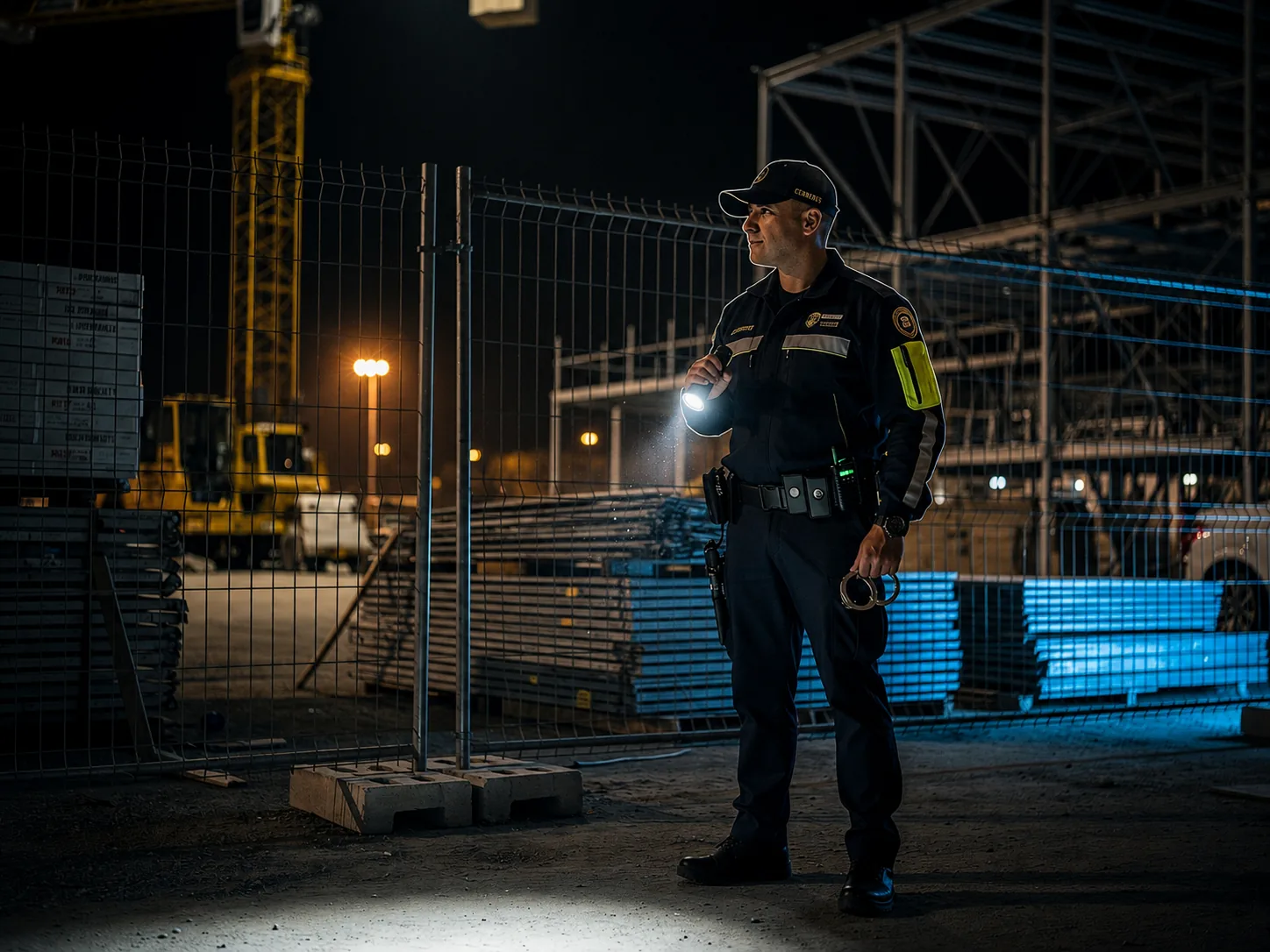
Licensed construction site security California job sites rely on protects materials, equipment, and the project timeline after the crew goes home. Our officers hold the site overnight, on weekends, and over holidays, verifying fencing and gates, locking and sealing containers, patrolling material yards, and photographing high-value equipment so every round is on the record.
What a construction security shift covers
On construction site security California assignments, officers work the hours when sites are most vulnerable: after hours, weekends, and holidays. They verify perimeter integrity, checking fencing tension, gate locks and chains, signage visibility, lighting, and erosion control, then lock and seal containers, trailers, and equipment cabs. Every round is logged with a timestamp, GPS coordinates, photos, and officer observations.
Coverage when the site is empty
The overnight and weekend window is when theft happens, so that is where the officer's attention sits.
Protecting materials and heavy equipment
Copper wiring, power tools, fuel, lumber, and heavy machinery are the primary theft targets on a construction site security California post. Officers confirm container seals, verify trailer doors, spot-check material inventory against delivery tickets, record fuel levels, and photograph equipment hour meters. For the highest-value items, GPS trackers with geofence alerts add a second layer of protection.
Chain of custody on every asset
Nightly reports give insurers and owners a documented record of what was secured and when.
Coordinating with the general contractor and trades
Job sites change daily. Our officers coordinate with the GC superintendent, the safety manager, the fire protection subcontractor, and trade foremen under a construction site security California plan. Access rules are enforced through an authorized-personnel log, visitor verification at the main gate, delivery checks against the purchase order list, and a no-tailgating policy.
Security that fits the schedule
Access rules and hot-work permits are enforced without slowing the trades or the delivery window.
What Construction Site Security Includes
Coverage ranges from a dedicated overnight post to a mobile patrol route, matched to the phase and the risk.
Perimeter and access control
The main gate is the primary control point. On a construction site security California post, officers verify authorized personnel, log visitors, check deliveries against the purchase order list, and prevent tailgating. Secondary gates stay locked and sealed unless a delivery is active, and the perimeter fence is verified on every round.
One controlled entry
A staffed gate and a sealed perimeter remove the easy access most theft depends on.
Material and equipment checks
Officers lock and seal containers and equipment cabs, spot-check lumber, copper, and fuel against delivery tickets, and photograph hour meters and fluid levels on excavators, loaders, and generators. Findings feed a nightly construction site security California report with a complete chain-of-custody record.
Small findings, caught early
An open container or a cut fence found on patrol is cheaper to fix than the loss it would invite.
Fire watch integration for hot work
When welding, cutting, or torch-applied roofing triggers NFPA 51B requirements, fire watch integrates with the construction site security California assignment. The same dual-certified officer, or a dedicated fire watch officer, assumes the watch with no coverage gap, and the log is signed for the fire marshal.
One team, two duties
Combining the post and the watch avoids the handoff gap that inspectors look for.
How Construction Site Security Works
Deployment is right-sized to the phase, from first grading to the final punch list.
Site survey and phase-based planning
We walk the site with the superintendent, map access points, material yards, and equipment stores, then match coverage to the current phase for the construction site security California contract. Early grading usually needs a mobile route; vertical construction with equipment on site usually needs a fixed main-gate post plus a mobile perimeter.
Right-sized, not overbuilt
Coverage scales to the phase so you never pay for a fixed post a job does not yet need.
Shift handoff and supervision
At shift change the outgoing officer briefs the incoming officer in person and hands over the log, so nothing is lost. Field supervisors make unannounced construction site security California visits, and our command center stays reachable around the clock for backup.
Supervision you can verify
Checkpoint scans and supervisor visits confirm officers are where they should be, when they should be there.
Escalation and rapid upgrade
If a theft incident, a copper price spike, or schedule pressure raises the risk, we can upgrade the construction site security California coverage from mobile patrol to a fixed post within 24 hours, on the same contract, the same officer pool, and the same reporting platform.
Flexible by design
Risk changes with the phase, so the coverage can change with it.
Where Construction Site Security Fits Best
Construction officers protect a wide range of active job sites across California.
Vertical construction and equipment-heavy phases
Once equipment and materials are staged, a fixed main-gate post with a mobile perimeter is the usual recommendation. Officers protect generators, compressors, specialty tools, and staged electrical gear, and document every check for insurance and subcontractor accountability.
High-value, high-consequence
When a single theft can delay the whole schedule, a visible post changes what a thief will attempt.
Multi-site and lower-risk phases
For grading, site preparation, or punch-list work, one mobile route can cover three to five sites a night with randomized timing, spreading visible deterrence across a portfolio at a fraction of fixed-post cost.
More ground, lower cost
One route covers many sites, so presence scales without an officer at every address.
Why California Businesses Choose Construction Site Security
Contractors and owners choose our teams for after-hours reliability, documented reporting, and integrated fire watch.
Reliable after-hours presence
Our officers are trained for the overnight, weekend, and holiday windows when sites are unattended. They verify the perimeter, secure containers and equipment, and photograph the site, so the morning crew arrives to a documented, undisturbed job site.
The hours that matter most
Theft and vandalism cluster in the empty hours, so that is where we concentrate the presence.
Documented reporting and insurance support
Every shift produces a nightly digital report with timestamps, GPS coordinates, photos, and officer observations. That record gives owners and insurers a clear account of what was checked and secured, which supports builder's-risk and theft claims.
Proof of every round
GPS-tagged photos remove any doubt about whether a patrol actually happened.
Construction Site Security FAQ
Answers to the questions general contractors and owners ask most often about job site coverage.
Why do construction sites need security?
Job sites hold high-value, portable assets such as copper, tools, fuel, lumber, and machinery with minimal overnight staffing. Multiple access points, changing perimeters, and predictable crew schedules create predictable vulnerability windows. Insurance carriers often require documented security for builder's-risk policies.
In short
Portable high-value assets and predictable empty hours invite theft, and insurers often require documented security.
What does a construction security guard do on a typical overnight shift?
Officers verify perimeter fencing and gate locks, lock and seal containers and equipment cabs, patrol material yards, photograph hour meters and GPS trackers, and log all findings with a timestamp and GPS coordinates. They coordinate with the GC superintendent on access and deliveries and trigger immediate alerts for breaches.
In short
Verify the perimeter, secure containers and equipment, patrol material yards, and log every finding with GPS.
Can security guards protect construction equipment and materials?
Yes. Officers verify container seals, lock equipment cabs, photograph hour meters, spot-check material inventory against delivery tickets, and can deploy GPS trackers with geofence alerts on high-value assets. Nightly reports provide chain-of-custody documentation for insurance and accountability.
In short
Yes. Seals, locked cabs, verified inventory, and GPS-tracked assets create a documented chain of custody.
Can construction security monitor gates and access points?
Yes. The main gate is the primary access control point, with an authorized-personnel log, visitor verification, delivery verification against the purchase order list, and no tailgating. Secondary gates stay locked and sealed unless a delivery is active, and all access events are logged.
In short
Yes. The main gate controls verified access and logged deliveries while secondary gates stay sealed.
Can construction sites use mobile patrol instead of a fixed post?
Yes, for lower-risk phases such as grading, site prep, or punch-list work, and for multi-site general contractors. Mobile patrol hits three to five sites a night with randomized timing. For vertical construction with equipment on site, a fixed main-gate post plus a mobile perimeter is recommended.
In short
Yes, for lower-risk and multi-site work, while equipment-heavy phases suit a fixed post plus mobile perimeter.
What is Construction Site Security?
Construction site security provides after-hours, weekend, and holiday protection for active job sites. Officers secure perimeter fencing, access gates, equipment yards, and material storage — preventing theft of copper, heavy machinery, tools, and lumber. Coverage scales from single-site fixed posts to multi-site mobile patrol routes, with fire watch integration for hot work.
What You Get
1 Cerberus construction site security includes:
- 01After-hours/weekend/holiday coverage when sites are most vulnerable
- 02Perimeter verification: fencing, gates, signage, lighting, erosion control
- 03Equipment and material protection: containers, trailers, copper, lumber, fuel, heavy machinery
- 04Nightly digital reports with timestamped photos, GPS logs, and officer observations
- 05Mobile patrol option for multi-site or lower-risk phases
- 06Integrated fire watch for hot work (welding, cutting, roofing) per NFPA 51B
Construction Site Security Coverage Across California
We provide construction site security throughout California, with coverage across major regions and key cities.
Bay Area
Northern California business and technology hub
Cities: San Francisco, San Jose, Oakland, Silicon Valley.
Southern California
Major metropolitan region with diverse industries
Cities: Los Angeles, San Diego, Pasadena, Malibu, Santa Barbara.
Sacramento Region
California capital and Central Valley gateway
Cities: Sacramento, Stockton, Modesto.
Why Choose 1 Cerberus for Construction Site Security
- 01Licensed & Insured: Every officer holds a valid BSIS guard card. Armed officers carry current firearms permits and full liability coverage.
- 02Rapid Deployment: Officers on site within 24-48 hours of contract signing, with emergency coverage available within hours of your call.
- 03Digital Reporting: Time-stamped incident reports, GPS-verified patrols, and daily activity logs delivered to your inbox.
- 0424/7 Support: Our command centre is staffed around the clock and field supervisors are always reachable.
Get Protected Today
Ready to secure your property with construction site security?
Every security plan starts with a conversation. Tell us about your property and we will design coverage that fits your operation and your budget.
© 2026 1 Cerberus Security & Patrol. California Bureau of Security and Investigative Services (BSIS) — PPO 121682.