Security Service
Maritime Security Guards California — TWIC-Certified MTSA Port Officers
TWIC-certified MTSA-compliant protection for ports, shipyards, and waterfront facilities
- 24/7Coverage
- PPO 121682BSIS Licensed
- 10+Years Experience
Service Details
Maritime Security Services Overview
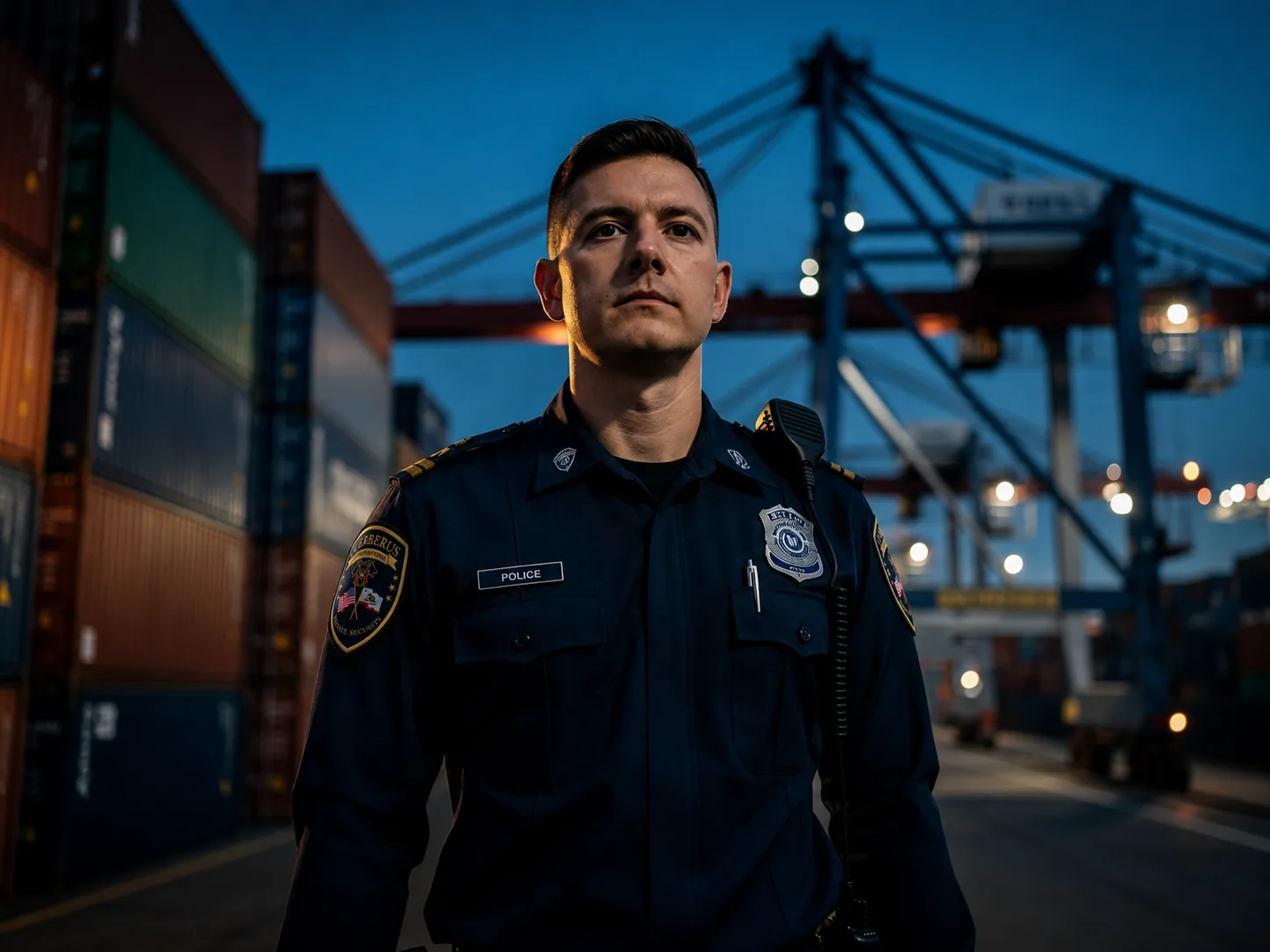
Maritime security guards California ports, terminals, and shipyards depend on hold valid TWIC cards and enforce each facility's security plan under 33 CFR 105. They verify credentials at the gate, watch vessels at berth, check container seals, and patrol the waterside perimeter. Every maritime security guards California assignment is documented in daily logs delivered to the Facility Security Officer.
What maritime security coverage includes
Coverage centers on three jobs: controlling access, protecting cargo, and watching the water. Officers read and match TWIC cards, escort visitors, inspect vehicles, and log every entry. They watch gangways during cargo operations, verify container seals, and patrol fence lines and waterfront access points. Because maritime security guards California posts sit inside a federal regulatory framework, every task follows the facility security plan rather than a generic checklist.
Federal rules, local officers
MTSA and 33 CFR 105 set the requirement; the officers on post are the ones who enforce it, shift after shift.
When a maritime post is required
Ports, marine terminals, shipyards, and waterfront warehouses fall under MTSA when they handle certain vessels or cargo. Those sites need credentialed gate control, restricted-area protection, and perimeter patrol. A maritime security guards California program can also cover private docks and waterfront facilities that want the same discipline without a full federal mandate.
Regulated or voluntary
Either way the work is the same: verified access, watched cargo, and a documented watch over the water.
Who we protect on the waterfront
We staff maritime security guards California terminals, shipyards, and waterfront operators rely on to protect stevedores, truck drivers, and crews. Officers are trained for hazardous-material awareness and Coast Guard boarding cooperation, so they work safely around cranes, containers, and bunkering operations.
Comfortable in an industrial setting
A port is not an office lobby; officers are briefed on the hazards and traffic of a working waterfront before their first shift.
What Maritime Security Services Cover
A maritime post combines access control, cargo protection, and perimeter watch into one continuous security presence.
Gate and access control
At the gate, officers verify each TWIC by reading the card, matching the photo, and checking expiration and revocation. Visitors are pre-registered and escorted, and vehicles are inspected for undercarriage devices and undeclared cargo. Every movement is logged with a timestamp, credential type, and purpose by the maritime security guards California officer on duty.
The gate is the first control
If access is verified once and consistently, the rest of the facility is easier to keep secure.
Cargo and container monitoring
Officers verify high-security seals at gate entry and exit, record seal numbers, and photograph anything that looks disturbed. They watch for cargo theft patterns such as fictitious pickups, driver impersonation, and yard infiltration. A maritime security guards California post also checks hazmat placards and reefer temperature logs.
Small tampering, big loss
A cut seal caught at the gate can prevent a theft that would otherwise be found at the far end of the supply chain.
Vessel, berth, and perimeter watch
Gangway watch during cargo operations helps prevent stowaways, while perimeter patrol covers fence integrity, lighting, and waterfront access such as ladders and ramps. Officers also enforce MARSEC level changes, tightening access restrictions as the Coast Guard directs. Each maritime security guards California round is recorded in the daily log.
Land and water together
A port is only as secure as its least-watched edge, so patrols cover both the fence line and the water.
How Maritime Security Services Work
Deployment starts with your facility security plan and stays aligned to it throughout the contract.
Plan alignment with your FSO
We begin by reviewing your facility security plan with your Facility Security Officer, then write post orders that match it. Daily logs are formatted for the FSO, and incidents are reported within the required timeframes. That keeps the maritime security guards California service inside the compliance envelope your facility already answers to.
One plan, one standard
Post orders are drawn directly from the FSP so officers and the FSO always work from the same document.
Training and credentialing
Every officer holds a current TWIC and completes MARSEC level training, facility-specific familiarization, hazardous-materials awareness, and Coast Guard boarding protocols. These assignments also cover drill participation and MARSEC change procedure.
Credentialed before the gate
No officer takes a waterfront post without the TWIC and training the facility requires.
Drills and MARSEC changes
We staff and document the required drills, including quarterly exercises and an annual full-scale drill, and we debrief each one with your team. When the Coast Guard changes the MARSEC level, officers put the matching restrictions in place quickly. Supervisors visit the posts and keep records ready for inspection.
Ready for inspection
Training records, drill logs, and incident reports are kept organized for Coast Guard review.
Where Maritime Security Services Fit Best
Maritime coverage suits any waterfront site where verified access and watched cargo matter.
Ports, terminals, and shipyards
Commercial ports, marine terminals, and shipyards use maritime security guards California services for gate control, berth watch, and container monitoring. Coverage scales from a single-berth terminal to a multi-berth port with dedicated posts.
Scaled to the berths
The staffing model grows with the number of gates, berths, and shifts you operate.
Private docks and waterfront warehouses
Private docks, waterfront warehouses, and marine construction sites use the same coverage to prevent theft, trespass, and unauthorized docking even when federal rules do not strictly apply.
Protection without a mandate
A site can still face theft and trespass; the same disciplined coverage prevents both.
Why California Businesses Choose Maritime Security Services
Clients choose our maritime teams for regulatory fluency, credentialed officers, and clean documentation.
TWIC-certified, MTSA-literate officers
Every officer on a maritime security guards California post holds a valid TWIC and understands how the facility security plan governs daily work. 1 Cerberus is a licensed PPO 121682, fully insured, and staffed for waterfront assignments across California.
Credentials you can verify
Licensing, TWIC, and training records are available to your security team on request.
Documentation built for regulators
Daily logs, incident reports, and drill records are produced in the formats your FSO and the Coast Guard expect. That documentation discipline is part of every waterfront contract we hold.
Paperwork that holds up
When an inspection comes, the records are already in order.
Maritime Security Services FAQ
Answers to the questions port and terminal managers ask most often about maritime coverage.
What does maritime security include?
Maritime security includes TWIC-verified gate control, vessel and berth gangway watch, container seal verification, cargo theft prevention, and land and waterside perimeter patrol. It also includes MARSEC level enforcement and FSO coordination with daily logs, incident reporting, and drills under the 33 CFR 105 facility security plan.
In short
Verified gate control, berth watch, cargo monitoring, perimeter patrol, and MARSEC enforcement under 33 CFR 105.
Can maritime security guard ports and shipyards?
Yes. We cover commercial ports, shipyards, marine terminals, private docks, and waterfront warehouses across California. Coverage scales from single-berth private terminals to multi-berth public ports, and every maritime security guards California officer holds a valid TWIC and completes facility-specific MARSEC training.
In short
Yes. Ports, shipyards, terminals, docks, and waterfront warehouses, scaled to the site.
Can maritime security include cargo monitoring?
Yes. Officers verify high-security seals, recognize cargo theft patterns such as fictitious pickups and yard infiltration, verify hazmat placards, and monitor reefer temperatures with awareness of seal-cutting tools, fake documents, and GPS jammers.
In short
Yes. Seal integrity, theft-pattern recognition, hazmat checks, and reefer monitoring.
Can maritime security include access control?
Yes. Gate control verifies TWIC cards by read, photo match, and revocation check, with visitor escort, vehicle inspection, and manifest cross-reference. Entries are logged with a timestamp and purpose, and MARSEC changes are implemented within fifteen minutes of the Coast Guard notification.
In short
Yes. TWIC verification, visitor escort, vehicle inspection, and logged entries.
How are MARSEC level changes handled?
When the Coast Guard raises or lowers the MARSEC level, officers apply the matching access restrictions to every post. Visitor escorts, vehicle inspection, and restricted-area rules tighten or relax to match the level, and the change is documented in the daily log.
In short
Officers apply the matching access restrictions at every post and log the change.
What is Maritime Security?
Maritime security provides TWIC-certified, MTSA-compliant protection for ports, shipyards, marine terminals, and waterfront facilities. Officers hold valid Transportation Worker Identification Credentials (TWIC). They complete Maritime Security (MARSEC) level training and enforce facility security plans under 33 CFR 105. Coverage includes gate access control with TWIC verification, vessel and berth security, container seal monitoring, cargo theft prevention, and coordination with the Facility Security Officer (FSO).
What You Get
Our maritime security solution delivers:
- 01TWIC-certified officers: valid credentials, MARSEC training, FSP enforcement
- 02MTSA compliance: 33 CFR 105 FSP enforcement, Coast Guard inspection readiness
- 03Gate access control: TWIC verification, visitor escort, vehicle inspection, audit trail
- 04Container and cargo security: seal integrity, theft prevention, hazmat monitoring
- 05Vessel and berth security: gangway watch, stowaway prevention, MARSEC enforcement
- 06FSO partnership: daily logs, incident reporting, drill participation, MARSEC changes
Maritime Security Coverage Across California
We provide maritime security throughout California, with coverage across major regions and key cities.
Bay Area
Northern California business and technology hub
Cities: San Francisco, San Jose, Oakland, Silicon Valley.
Southern California
Major metropolitan region with diverse industries
Cities: Los Angeles, San Diego, Pasadena, Malibu, Santa Barbara.
Sacramento Region
California capital and Central Valley gateway
Cities: Sacramento, Stockton, Modesto.
Why Choose 1 Cerberus for Maritime Security
- 01Licensed & Insured: Every officer holds a valid BSIS guard card. Armed officers carry current firearms permits and full liability coverage.
- 02Rapid Deployment: Officers on site within 24-48 hours of contract signing, with emergency coverage available within hours of your call.
- 03Digital Reporting: Time-stamped incident reports, GPS-verified patrols, and daily activity logs delivered to your inbox.
- 0424/7 Support: Our command centre is staffed around the clock and field supervisors are always reachable.
Get Protected Today
Ready to secure your property with maritime security?
Every security plan starts with a conversation. Tell us about your property and we will design coverage that fits your operation and your budget.
© 2026 1 Cerberus Security & Patrol. California Bureau of Security and Investigative Services (BSIS) — PPO 121682.